


The OOPS Strategy: How to Profit from Other Traders’ Mistakes

In the world of trading, few names command as much respect as Larry Williams. This legendary trader, who famously turned $10,000 into over $1 million in a single year, is the author of many popular trading techniques. One of his most famous and favorite setups goes by an amusing name: the OOPS strategy.
If you are looking for a simple yet highly effective day trading approach that leverages crowd psychology and price gaps, the OOPS strategy is exactly what you need to know.
What Does “OOPS” Actually Mean?
The name “OOPS” is not a complex acronym. It expresses exactly what an inexperienced trader says when they realize the market is moving against them: “Oops!”
The strategy is built on morning price gaps. Markets often open with a significant jump up or down due to panic, euphoria, or overnight news. Amateur traders tend to jump into these gaps immediately, expecting the momentum to continue. Professionals (and the OOPS strategy), however, wait for the moment when the market loses this initial energy and reverses.
The Core Idea: You profit from the market “trapping” amateurs who bought too high or sold too low. When they realize their mistake and start closing their positions in panic, they push the price exactly in your direction.
How the Strategy Works in Practice
The strategy relies on strict yet highly straightforward mechanical rules. It is divided into two basic setups.
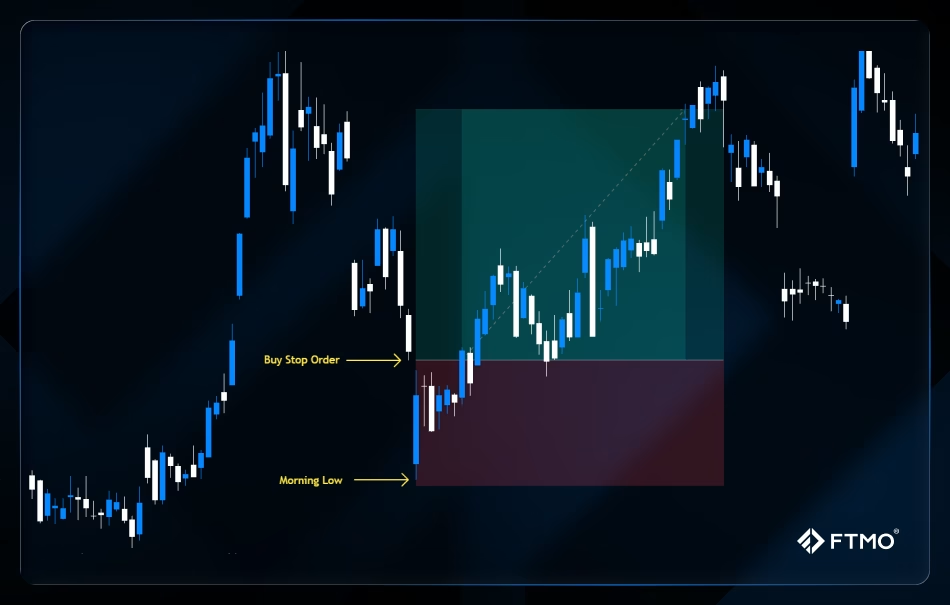
1. Bullish OOPS (Buy Setup Example)
You look for this scenario when the market opens with a significant drop driven by panic.
- Condition: Today’s opening price (open) must be lower than yesterday’s lowest price (low). In other words, the market opened with a gap down.
- Entry: Place a buy order (Buy Stop) exactly at the level of yesterday’s low.
- Execution: If the price reverses upward and breaks through yesterday’s low, your order is triggered. The “trap” snaps shut, and the sellers who shorted at the very bottom are now in a losing position.
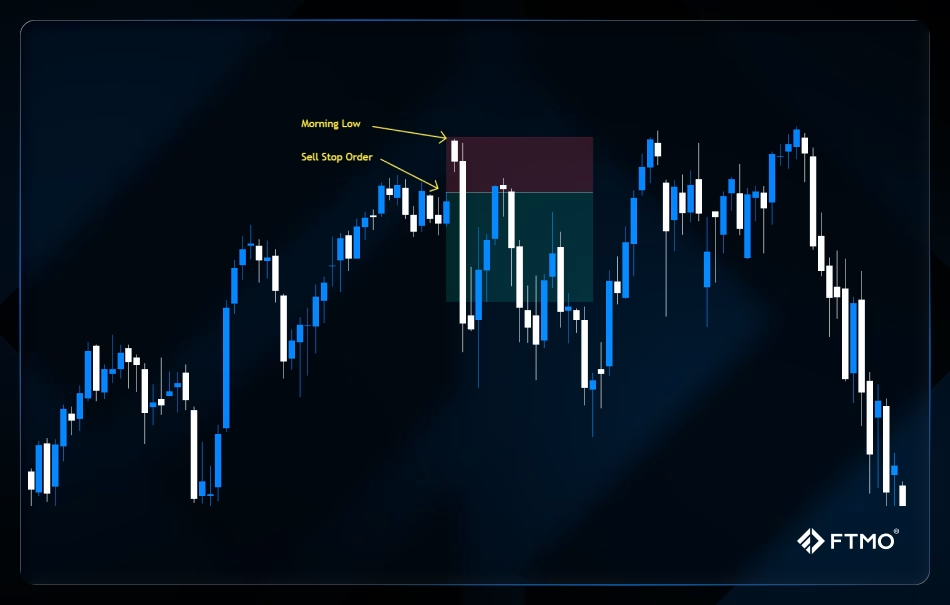
2. Bearish OOPS (Sell Setup Example)
You use this scenario when the market opens in a state of euphoria with a significant jump upward.
- Condition: Today’s opening price (open) must be higher than yesterday’s highest price (high). The market opened with a gap up.
- Entry: Place a sell order (Sell Stop) exactly at the level of yesterday’s high.
- Execution: If the market loses steam and starts falling back below yesterday’s high, you enter a short position. The euphoria is over, and the buyers from the market open are now losing money.

Capital Protection: Where to Place the Stop Loss?
No strategy, not even one from Larry Williams, is 100% foolproof. That is why protecting your capital is absolutely critical.
In the OOPS strategy, the stop loss is placed as follows:
- For a Bullish OOPS: below today’s morning low (the low of the current day).
- For a Bearish OOPS: Above today’s morning high (the high of the current day).
If the market does end up continuing in the direction of the morning gap, you exit the trade with a controlled, relatively small loss.
Why is the OOPS Strategy So Successful?
- It leverages pure psychology: opening gaps are often an overreaction of the crowd. The OOPS strategy rationally waits for emotions to subside.
- Clearly defined risk: entries and exits (stop losses) are strictly determined by yesterday’s and today’s price levels. No complex indicators are required.
- High Risk to Reward Ratio (RRR): if you catch a proper trend reversal, the potential profit can be several times larger than the initial risk defined by your stop loss.
Summary
Larry Williams’ OOPS strategy is beautiful proof that simplicity and an understanding of market psychology are often all you need in trading. It is not about predicting the future, but about reacting to what the market is showing us.
Before testing this strategy on the FTMO Challenge, make sure to test it on the FTMO Free Trial first or using historical data (backtesting). Every market (whether stocks, forex, or commodities) has its own characteristics, and it is crucial to see how this strategy performs on each.

All information provided herein is intended solely for educational purposes related to trading on financial markets and does not constitute investment advice or serve in any way as a specific investment recommendation. Please read the full disclosure here.






- As many Free Trials as you need
- Up to $200,000 account
- No time limit

- Unlimited Evaluation Accounts
- Trade with up to 3 Sim-Funded accounts
- Up to $450,000 in simulated capital
- Keep up to 90% of your simulated profits


Worldwide Reviews