New
1-Step FTMO Challenge
Start now
“You are your own enemy when it comes to trading.” EN
FTMO Traders Q&A

“You are your own enemy when it comes to trading.”

Trading is a journey of continuous self-improvement where the strategy is only half the battle. In this Q&A, Christopher, Jayden, and Vello discuss how they moved past emotional decision-making, why they prioritise capital protection, and how they turned strict rules into long-term professional habits.

Trader Christopher: “My priority is consistency, discipline, and capital protection.”

Christopher Profile picture

How does your risk management plan look like?

I apply a strict, rule-based risk management plan. Each trade risks a fixed amount, always 1%, calculated based on the Stop Loss. All trades have a predefined Stop Loss and a minimum 2:1 reward-to-risk ratio. My priority is consistency, discipline, and capital protection.

What inspires you to pursue trading?

Trading inspires me as a path of continuous personal development and discipline. It pushes me to improve my mindset, emotional control, and decision-making daily. I am driven by ambitious goals and the desire to perform at a professional level. Beyond trading, I constantly work on self-improvement and long-term excellence. My motivation comes from growth, consistency, and the pursuit of high personal standards.

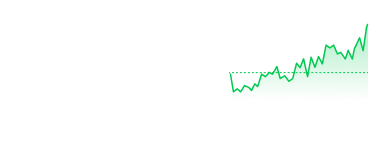
Christopher Balance Curve

Do you have a trading plan in place, and do you follow it strictly?

Yes, I follow a discretionary trading plan with clearly defined risk rules. I evaluate each trade based on probability using a combination of fundamental, sentiment, and technical analysis. Rather than a fixed checklist, I assess whether the potential reward justifies the risk. Risk is always predefined and controlled before entering a trade. I only execute trades when multiple factors align in favour of high‑probability outcomes.

Do you plan to take another FTMO Challenge to manage even bigger capital?

Yes, I plan to continue with FTMO as a stepping stone for growth. I see prop firms as a way to build both skills and trading capital in a disciplined environment. My goal is to reach a capital size that allows me to trade my own funds professionally. After proving long-term consistency, I aim to eventually mentor or teach others.

How has passing the FTMO Challenge and Verification changed your life?

Passing the FTMO Challenge and Verification reinforced my confidence and discipline as a trader. It validated my risk management and decision-making under real pressure. This achievement increased my sense of responsibility toward capital management. It pushed me to raise my personal and professional standards. Most importantly, it confirmed trading as a serious long-term path for me.

What is the number one piece of advice you would give to a new trader?

My number one advice is to focus on mentorship and proven guidance. My breakthrough came not only from courses but also from being personally coached by mentors. Learning from strategies that have proven consistency over the long term made the difference. This accelerates progress and avoids costly mistakes. Trading success is built through guidance, discipline, and experience.

Trader Jayden: “Sticking with one strategy and learning to improve it is better in the long-term.”

Jayden Profile picture 2

Has your psychology ever affected your trading plan?

Yes, psychology is the number one killer in trading. Not trading itself, but you. You are your own enemy when it comes to trading. In my case, it's been family. I told my family that I'll be a millionaire when I found trading at 15, and it was the worst mistake I could've made in my entire life (I'm 19 now). Realistically, it will take me many years to reach that status, but telling my family puts pressure on me. Psychology has affected my trading plan a lot. I've tried many strategies, but none have worked. Sticking with one and learning to improve it is better in the long-term.

What was the hardest obstacle on your trading journey?

The hardest obstacles for me have been strategy, time, and consistency. First, I've been changing strategies a lot, always thinking there is a perfect strategy that can make me money. The thing is, it's not about finding the perfect strategy; it's about finding a strategy that fits you and improving on it. Secondly, time — finding time to trade and learn has been very difficult since I've been at college. I figured out the perfect time to trade XAUUSD is between 2:00 PM and 3:00 PM. However, being in the middle of the day, when people are busiest, does get annoying, but it is manageable in the long term. Finally, being consistent is very difficult for every trader. With trading, there are always going to be ups and downs, but as I say, two steps forward, one step back. That's consistent enough to make profits.

Jayden Balance Curve

How would you rate your experience with FTMO?

9/10. FTMO is a very good prop firm. Without FTMO, I wouldn't know how to scale in the future of my trading career. FTMO for me is completely different in terms of how everything just connects and works.

How does your risk management plan look like?

Always risk a fixed percentage, preferably 1% or below, to allow for losing streaks without blowing your account. I made an automatic Lot Size calculator that calculates my position size using the Stop Loss price, account capital, and risk percentage. My code calculates the Lot Size in real-time. Before, I had to use a website which I couldn't rely on long-term. Now I can trade on my phone using MT5 and TradingView simultaneously.

How did you eliminate the factor of luck in your trading?

All long-term profitable traders have an edge. People can profit from luck, but if you have a solid edge that works using past data, the chances it will work in the future are high. Remember, nothing is guaranteed in the market, just like in life. My edge has been risk management. Without it, you wouldn't be able to consistently scale and grow over time.

What is the number one piece of advice you would give to a new trader?

Do not overtrade; follow your plan. Don't tell anyone you trade (based on my experience); avoid FOMO at all costs; don't follow your emotions—be a machine.

Trader Vello: “I knew I had a strict boundary I couldn’t cross.”

Vello Profile picture

How would you rate your experience with FTMO?

I rate my experience with FTMO as very good. I have always received quick answers to my questions, and everything works as it should.

How did you manage your emotions when you were in a losing trade?

The best thing is to take a break and come back with a clear mind. It doesn’t always work, but it takes practice; as with any habit, it takes time. However, it’s doable and necessary if you want to be successful in trading. Without controlling your emotions, you won’t get far.

Vello Balance Curve

How did Maximum Loss limits affect your trading style?

Maximum Loss limits made me more disciplined and focused on risk management. I started planning my trades more carefully and avoided overtrading. It also helped me control my emotions because I knew I had a strict boundary I couldn’t cross.

Has your psychology ever affected your trading plan?

My psychology has affected my trading plan. At times, I’ve made emotional decisions or deviated from my strategy, especially after losses or wins. However, I’ve learned to recognise this and work on controlling my emotions by taking breaks and sticking to my rules.

One piece of advice for people starting the FTMO Challenge now.

Discipline and good habits.


This article is for informational purposes only, and some information may not reflect the current service offering or product features. Please always verify the latest terms on the official product pages.

About FTMO

FTMO has developed a two-step evaluation process to find trading talents. Upon successful completion, you may be eligible for an FTMO Rewards Account with a balance of up to $200,000 in simulated funds. How does it work?