







Trading and Drawdowns
Most of you are certainly familiar with drawdown, or have at least heard of it. A drawdown occurs when capital decreases below its highest level. You can learn more about drawdowns in this article!
What Is Drawdown?
We can encounter it everywhere – Forex, crypto, indices, stocks, etc. Almost every analyst or financial news outlet uses drawdown to describe a decline in value. Below you can find a chart from the financial agency Bloomberg showing the drawdown on the EURUSD currency pair.

But do you know the differences between the various types of drawdown? We have absolute drawdown, relative drawdown, and maximum drawdown. Let’s take a look at how these types differ and how they relate to our rules – Maximum Loss and Maximum Daily Loss.
Drawdown can be described as the difference between the highest and lowest point on a trading account. It is used to measure the risk associated with the account. It is generally divided into absolute and maximum drawdown.
Absolute Drawdown
To express the difference between the initial balance and the lowest point below it, we use the term absolute drawdown.
Here is a formula to calculate the Absolute Drawdown:
Absolute drawdown = Initial deposit − Lowest account value
For example, if the initial balance is 100,000 USD, the maximum achieved value is 150,000 USD, and the lowest value is 60,000 USD, then the absolute drawdown is:
100,000 USD – 60,000 USD = 40,000 USD.Absolute drawdown shows the largest historical loss compared specifically to your initial balance. While a 0 USD absolute drawdown indicates your account never dropped below the starting capital, it doesn’t reflect the risk exposure of your individual trades. In this example, the absolute drawdown was 40,000 USD.

Maximum Drawdown
To express the difference between the account’s maximum and the subsequent minimum, we use maximum drawdown. This shows the potential loss. If the resulting value is higher than the profit potential of a currency pair, it is usually a sign of a poor investment.
Maximum drawdown = distance between the highest and lowest point (maximum and minimum peak).
Using the values from the previous example:
Maximum drawdown = 150,000 USD – 60,000 USD = 90,000 USD
90,000 USD is the maximum drawdown for this account.

Drawdown
To express the ratio between the maximum drawdown and the maximum equity value, we use relative drawdown.
It is calculated by dividing the maximum drawdown by the highest account value (maximum equity) and multiplying the result by 100 to convert it into a percentage.
Using the previous example:
90,000 USD / 150,000 USD × 100 = 60%.

Maximum Daily Loss and Maximum Loss
Although we have described different types of drawdown, when trading with FTMO you will not see these terms very often. Instead, we use our own terms – Maximum Daily Loss and Maximum Loss.
Maximum Daily Loss is a key rule not only in our Evaluation Process but also when trading on an FTMO Account. Depending on the selected account type, the rule is set at 5% (for the 2-Step FTMO Challenge) or 3% (for the 1-Step FTMO Challenge) of the initial account balance. According to this rule, the result of all floating (closed + open positions) profits/losses must not exceed the Maximum Daily Loss (hereinafter MDL).
Formula for MDL: Maximum Daily Loss = result of closed positions for the given day + result of open positions.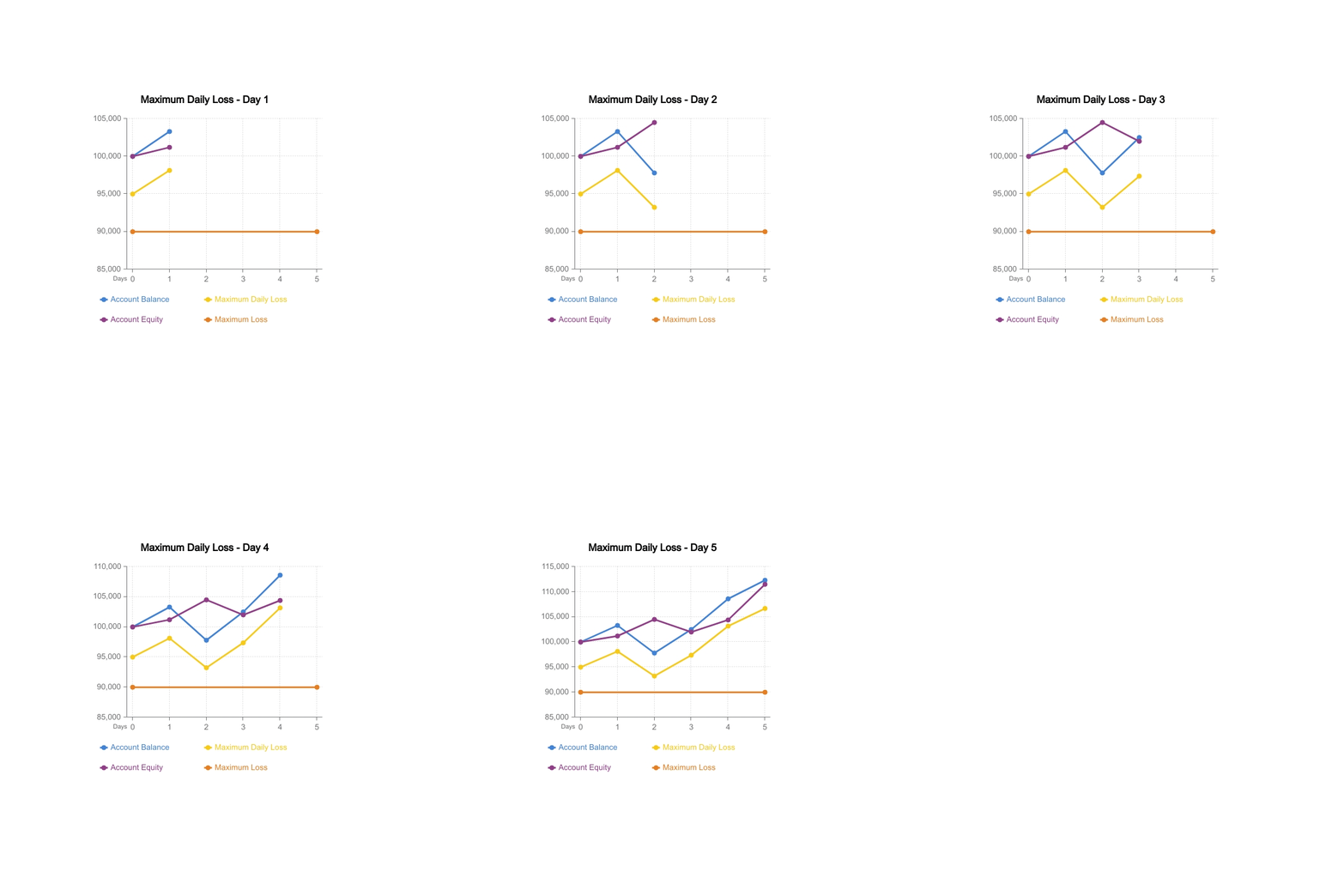
Above, you can see the account development over 5 days. The initial account balance is 100,000 USD. For the 2-Step FTMO Challenge, the MDL would be 5,000 USD, while for the 1-Step FTMO Challenge it would be 3,000 USD. This means that if the result of your closed + open positions exceed the limit, the rule would be violated. Please note that the MDL value is recalculated every day at midnight CE(S)T based on the account balance, giving you a fresh start for each subsequent trading day.
The difference between MDL and Maximum Loss (hereinafter ML) is that MDL is recalculated every day at midnight CE(S)T. ML for both account types is 10% of the initial account balance; however, in the 1-Step FTMO Challenge it works on an End-of-Day Trailing basis, meaning that the ML limit can move upwards according to your end-of-day balance. If you exceed the defined ML limit, it is considered a violation. Both MDL and ML also include commissions and swaps.
For a better understanding, let’s look at an example on 1-Step FTMO Challenge: You start with a 100,000 USD account. The Maximum Loss is 10,000 USD, so the initial ML limit is set at 90,000 USD. If your balance at midnight CE(S)T after the first trading day is 104,000 USD, the ML limit for the following day moves to 94,000 USD (104,000 − 10,000). If the end-of-day balance on any later day is lower, the limit does not decrease, as it is always based on the highest end-of-day balance achieved.
When comparing Maximum Daily Loss and Maximum Loss with traditional drawdown types, we can conclude that FTMO still takes drawdown into account. However, through the MDL and ML rules, we aim to mitigate risk not only for us but primarily for our traders, so that we can profit together. Although aggressive strategies may be profitable for a small percentage of traders, we focus on consistency, reliability, and experience.











- As many Free Trials as you need
- Up to $200,000 account
- No time limit


Worldwide Reviews